Last week, a MetaFilter member posted a link to what appeared to be a new website for The Dictionary of Obscure Sorrows, John Koenig’s decade-long project to make a “dictionary of made-up words for emotions that we all feel but don’t have the words to express.”
The Dictionary of Obscure Sorrows website… or is it?
Strangely, it also includes the entire text of the book, from its opening 800-word foreword to a complete archive of all 311 neologisms, with their accompanying definitions, etymology, and short essays, all penned by Koenig.
The book’s original photo-collage illustrations made by Koenig and several other artists are conspicuously missing. Instead, each word has an AI-generated image made with DALL-E 2, riddled with the errors and artifacts typical of that model.
“it’s half-past IŊΨ-o-clock”
A banner at the top of the homepage encourages visitors to “Generate your own words using AI – give your sorrows a voice!” The Submit A Sorrow feature lets you describe a feeling, and then uses OpenAI’s GPT-4 to generate the new word, etymology, and definition, which go into a gallery of “User-Generated Sorrows” with AI generated art.
MetaFilter members were immediately suspicious, and so was I. My wife Ami and I made a card game in 2022, Lost for Words, partly inspired by Koenig’s project. We own a copy of the book, and I’d followed it online for years. The embrace of AI seemed out of character.
If you know any word from the project, it’s probably “sonder,” which spread far beyond its origin, making its way into common parlance and eventually to Dictionary.com and Merriam-Webster.
sonder n. the realization that each random passerby is living a life as vivid and complex as your own—populated with their own ambitions, friends, routines, worries and inherited craziness—an epic story that continues invisibly around you like an anthill sprawling deep underground, with elaborate passageways to thousands of other lives that you’ll never know existed, in which you might appear only once, as an extra sipping coffee in the background, as a blur of traffic passing on the highway, as a lighted window at dusk.
Other words coined by Koenig have found a life outside his project. You may have encountered “anemoia” (a feeling of nostalgia for a time or place you’ve never known), “vellichor” (the strange wistfulness of used bookstores), or maybe “monachopsis” (the subtle but persistent feeling of being out of place).
But “sonder” is the breakaway success. I’d wager most people who have heard the word have no idea it was coined by a guy on Tumblr in 2012.
That success landed Koenig a book deal with Simon & Schuster, and the book became a New York Times bestseller on its release in November 2021.
Two years later, around August 2023, the new Dictionary of Obscure Sorrows website launched, but curiously, with no reference to it from the official Tumblr page or social media.
A Slick Impostor
The mission of Koenig’s project, in his own words, is to “shine a light on the fundamental strangeness of being a human being.”
So it felt strange that he would now be encouraging people to generate new words and definitions with LLMs, a contentious technology that has been trained on so much human writing, but can’t know what it’s like to be human.
I reached out to John Koenig directly to ask if he was involved with the website. He emailed back an hour later:
Yeah man, I had nothing to do with it. Don’t know what to think or do about that, as the site is pretty slick. Nicer than my own, really.
It wasn’t hard to find who was responsible since they list themselves in the “Site Credits” in the footer of every page: Qontour (formerly Prompt Digital), a web design and marketing agency based in San Francisco.
The only hint that the site isn’t authorized is this page in their portfolio, where they talk about how “Qontour built the interactive digital platform – designing the site in Webflow, generating an AI-powered image library, and launching a feature that lets visitors submit their own sorrows and add new definitions to the dictionary.”
On that page, they refer to themselves as “fans” of the book: “The site gives fans (like us) one place to find everything – videos, reviews, interviews, and purchase links – instead of searching across a dozen platforms.”
The problem, of course, is that being a fan doesn’t give them the right to repurpose any of the material for their site.
Copyright and Confusion
In the footer of Qontour’s unauthorized site, they added a copyright notice acknowledging that they don’t own any of the rights to the material on the site, while also licensing all the user-submitted words into the public domain with a CC Zero license.
This betrays a fundamental misunderstanding of how copyright works. Qontour did not have the right to publish the entirety of Koenig’s book to showcase their web design skills.
They also submitted their site to Webflow’s directory to advertise their design business. “This endeavor showcased our expertise in website design, AI-generated content, and extensive content integration.”
Below the button to “Hire Qontour,” a small link to “Copyright Info” misrepresents their work:
The Dictionary of Obscure Sorrows by Qontour is licensed under a Creative Commons Attribution-NonCommercial-NoDerivatives 4.0 International License. All Rights Reserved. In other words, it’s someone else’s work so you can’t copy it or edit it for any reason, but you can share it with others.
Needless to say, you can’t relicense content you don’t own.
Complicating their claims of it being a fan tribute, Qontour also used their own Amazon affiliate code throughout the site, created under their previous name Prompt Digital, giving them a cut of all book sales.
Those commissions may have been meaningful over the last few years, since the unofficial site is now the top search result for virtually every query related to the book, including the book’s title, the wordscoinedinthebook, and even John Koenig’s name. In every Google search I’ve tried, the unofficial site ranks higher than the official site, the publisher’s site, or Wikipedia.
This is made worse by the rapid shift from traditional web search to conversational AI search, which is easy to manipulate, hides sources, and collapses context into simple answers.
ChatGPT and Gemini both link to the bootleg as the official website, and both claim that John Koenig is the one that created it.
Gemini (left) and ChatGPT (right)
This creates legitimate confusion over its authorship, and arguably, damages the reputation of the project and book with its enthusiastic embrace of AI. The person who originally posted the site to MetaFilter thought it was the official site, and the commenters in the thread then, reasonably, questioned whether the book itself was written by AI.
I asked Koenig if his publisher was planning to issue a cease-and-desist takedown to the site, but didn’t receive a response.
After emailing him, I realized that Simon & Schuster did make moves last year to limit its reach. They filed two DMCA takedowns (1, 2) with Google last July, asking them to remove two pages from the bootleg site from their results. It had no effect.
AI and Consent
It’s one thing for a fan to share or remix copyrighted material out of love for the source material, with no commercial motive. (“No copyright intended!”) It’s another for a marketing agency to take an entire living author’s book, replace its art with AI slop, add an AI word generator, monetize the traffic, promote it in their portfolio, and then outrank the official site everywhere.
This is a more flagrant form of plagiarism than you typically see these days, where human-authored works are laundered with an AI model into something that’s different enough from its sources to avoid legal issues.
But it’s not surprising to see it coming from an agency that has leaned into generative AI so heavily. As they proudly explain, “Every page on this site was written in Claude” using an “author persona” that they call “Q.”
What’s missing here is consent, which feels like the original sin of AI. As I’ve written about manytimesbefore, generative AI models are all trained on a massive corpus of human-authored works without attribution, consent, or compensation, extracting value from creators while centralizing power among a tiny handful of massive tech companies.
On a much smaller scale, Qontour could have reached out to John Koenig for permission to republish his work, collaborating with him on a new, improved website for the book. He might have asked them to limit it to just the words published on his Tumblr, asked for them not to build AI features, or maybe just said no to the whole thing, which would be his right.
The Last Word
What happened to The Dictionary of Obscure Sorrows may have been more brazen, but it isn’t an isolated case.
It’s part of a broad trend happening across the web, where people are using AI to repackage, optimize, and replace the authoritative sources it was trained on for profit.
Nearly every day, I get emailed a newly-launched, obviously-vibecoded website filled with AI-generated content that was designed to siphon attention away from human creators: bloggers, authors, journalists, artists, musicians, and anyone else who slowly, painstakingly makes things for a living. I’m not even sure anymore that the emails I’m receiving are sent by a human.
The feeling of seeing something you love ingested and repurposed by a machine designed to replace the person who made it seems like a uniquely modern sorrow.
(This blog essay is overdue because I'm still waiting for new prescription glasses and writing while cross-eyed with text zoomed to 250% is tedious. They should be here later this week. Meanwhile ...)
Back in January 2022 I wrote an essay revisiting my predictions for 2017. My review of 2017's stab in the dark began, "it spanned three blog posts and ended happily in a nuclear barbecue to put us all out of our misery: start here, continue with this, and finale: and the Rabid Nazi Raccoons shall inherit the Earth."
I'll actually stand by those 2017 predictions, which were weirdly not that far off the mark although Queen Elizabeth II outlasted my prediction by several years.
But my 2022 predictions?
Oh boy.
Look, for an amateur futurologist writing in January of 2022 it was arguably forgivable to miss the US electorate being so boneheadedly stupid that they'd re-elect the most corrupt president in their nation's history, at the head of a Gish gallop of barkingly ignorant and destructive cranks and conspiracy theorists determined to tear down the republic and destroy its vital institutions, all in the name of returning the social order (per the Project 2025 plan) to the 50s--the 1850s, that is, not the 1950s. With 20/20 hindsight, what I missed was the now-obvious wave of media ownership consolidation, including corporate social media such as X, Meta, and Google, in the hands of a narrow class of billionaire oligarchs. I also missed the complacent incompetence of the Biden administration with respect to organizing their succession plans--it was obvious that by 2024 he'd be vulnerable to campaign ratfucking on grounds of his age, and his anointed successor was guilty of being (a) too female and (b) non-white, rendering her unacceptable to a large chunk of the voters.
But, even if you forgive my failure to recognize the catastrophic collapse of the US as a credible hegemonic superpower over the past 3-4 years, I can only hang my head in shame over my failure to anticipate the Ukraine war, which broke out six weeks after that blog essay. Let alone to anticipate a revolution in military affairs as profound as that brought about of the first world war.
Similiarly, I have no excuse for not recognizing that an Israel with politics dominated by Benjamin Netanyahu would go Full Nazi sooner rather than later, as the genocide in Gaza and the program to build a Greater Israel in Lebanon demonstrate. I mean, I grew up going to synagogue and have visited Israel more than once! I should have seen the signs, they were all there as far back as the 1980s. Mea culpa. (And fuck those guys.)
While I correctly recognized the EV transport revolution, I missed the concurrent solar power and grid-scale battery revolution, now very visibly in train and arguably more important than the arrival of cheap electric cars and cheaper e-bikes. I didn't notice the global supply chain crisis of 2021-2023, even then gathering pace, although it didn't impact consumer prices for a few more months.
Possibly my worst miss is that I completely discounted the profound social impact of LLMs (or so-called "AI"), not simply as a massive technology sector investment bubble and happy hunting ground for snake oil salesmen and grifters, but as a corrosive influence on population-level critical thinking. I should have seen it coming--I read Joseph Weizenbaum's Computer Power and Human Reason back in the 1980s--but I didn't recognize just how unable to see past the ELIZA illusion most people would prove to be.
Nor did I expect the transhumanists, extropians, and the rest of the hairball of beliefs now congealing into the syncretistic techno-religion of TESCREAL to have seized control of trillions of dollars of private equity and not only be arguing about the Singularity but to be squabbling over who gets to run it (with a side-order of racism and eugenics on top, because every flavour of crank batshittery is so much better with a side-order of fascism and concentration camps).
So I'm sticking a flag in the ground here and admitting: I am officially a shit futurologist.
Back in 2022, and before that, in 2017 and even in 2007, I espoused a general rule of thumb about predicting the future, that:
Looking 10 years ahead, about 70% of the people, buildings, cars, and culture is already here today. Another 20-25% is not present yet but is predictable -- buildings under construction, software and hardware and drugs in development, children today who will be adults in a decade. And finally, there's about a 5-10% element that comes from the "who ordered that" dimension
2022 forced me to update the ratio to:
20% of 10-year-hence developments utterly unpredictable, leaving us with 55-60% in the "here today" and 20-25% in the "not here yet, but clearly on the horizon" baskets
Anyway, it's now 2026, and I officially give up.
The Stross Ratio for predicting events ten years hence is now 60/10/30. That is: 60% of the people, buildings, and culture are here today. 10% is predictably on the drawing boards, and a whopping 30% is utterly unpredictable.
Airborne Hantavirus pandemic or global Measles pandemic, who the fuck knows what we're going to get--given that the US FDA is run by a crank who doesn't believe in the germ theory of disease and seems to be trying to spike vaccine development globally?
I'm reasonably confident that the Russian invasion of Ukraine will be over by this time in 2030--quite likely by this time in 2027, due to the collapse of the Russian domestic economy. I'm also reasonably confident that the US war on Iran will be over by this time in 2030, if only because Trump will most likely be dead or in palliative care (possibly following his removal in a soft coup via Article 25 of the US constitution, due to his very obvious current illness and decline). (Note that Trump's insistence on "running for a third term" is very probably a serious sign that the electoral process in the USA is no longer fully functional, under the aegis of the supreme court he appointed, as long as he survives. His successor may not be able to sustain his ability to ignore the law: if they can, then, well, the US Republic is over: it had a good run, from 1776 to 2026.) The AI bubble will have burst long before May 2027--the semiconductor pinch caused by the aforementioned helium supply crisis will cripple Nvidia's ability to manufacture chipsets for data centers, and the US DCs are all being built to run on diesel/kerosene burning gas turbine power plants anyway, the price of which has skyrocketed due to the gulf war.
I expect us to be well into Great Depression 2.0 by this time in 2030.
There will be some grounds for hope. The global energy transition to renewables will, by that point, be a done deal. It also means China will have replaced the USA as the global energy superpower--not because they dominate the transport routes for energy but because they manufacture 80% of the planet's EVs and PV panels and batteries. But that's a tenuous hold on superpowerdom. If the Chinese government throws its weight around in the 21st century the way the USA did in the 20th, it will rapidly find first-tier rivals building up their own manufacturing capability: meanwhile, PV/battery is inherently easier to distribute that large, centralized grid based power supplies, and the dronification of warfare means (at least in the near term) that rapid mechanized wars of maneuver are a non-starter: the "fog of war" is on the way out, replaced by highly precise targeting of advancing assets and the robotization of the front line.
In space, I'm pretty sure we will see a Kessler Syndrome event if the idiotic rush towards putting data centers in orbit goes anywhere. But I think it's not going to happen--SpaceX is inextricably tied to the current tech bubble, and when it pops Elon Musk is going to wish he had a bunker to hide in.
The main casualty of this decade is the ideological credibility of capitalism as a social organizational principle.
Enshittification, also known as platform decay, per wiki, is "a process in which two-sided online products and services decline in quality over time. Initially, vendors create high-quality offerings to attract users, then they degrade those offerings to better serve business customers, and finally degrade their services to both users and business customers to maximize short-term profits for shareholders." Systematic capture of the US government and the global system of trade by capitalists has resulted in the creation of a framework optimized for enshittification all round, and the result is the enshittification of everything--all the infrastructure of the capitalist world is decaying and on fire as the post-privatization owners loot it.
This is the Marx-predicted crisis of capitalism, and it's been in progress since the collapse of the USSR in 1991 removed the main ideological standard-bearer for opposition. It accelerated in 2008 with the global financial crisis, and again in 2020 when the pandemic provided top cover for the hyaenas to go on a looting spree. They've stripped the corpse of actually-existing social democracies everywhere to the bone, and now they're cannibalizing their own body politic. Disaster capitalism has finally come home to roost, and it won't end until the global financial system collapses. Meanwhile, the generation born in the 21st century has no time for their shit. We are moving into a political state weirdly reminiscent of the period between 1905 and the 1930s. If we're lucky we're going to get New Deal 2.0 and a brisk round of socialism: if we're unlucky, it's going to be guillotine time all over again.
A few weeks ago, a friend called me at 01:40 AM. Not texted. Called. For a brief second, my body prepared itself for bad news. Adulthood has conditioned most of us to believe that late-night calls only arrive carrying catastrophe. Someone in the hospital. Someone stranded. Someone dead. But nothing had happened.
She had just finished work, was driving home through near-empty roads in London, heard a song we both used to jam on together, and suddenly missed me. So she called. We spent thirty minutes talking about things that would sound painfully unremarkable on paper. Work fatigue. Bollywood gossip. How she was enjoying every bit of her married life. The indignity of back pain as soon as you touch thirty. A professor we once hated but now miss with alarming frequency. Nothing profound.
And yet after the call ended, I sat awake for a long time with the strange ache of having briefly encountered an earlier version of myself. Not younger exactly. Just…more reachable.
There was once upon a time when friendship did not require elaborate planning. We spoke for hours without checking calendars. Entire evenings disappeared on hostel terraces and tea stalls and long walks taken for absolutely no reason. Friendship in youth thrived on excess time – loose, unstructured, and gloriously wasteful.
However, somewhere between “Let’s catch up soon” and “Sorry, life has been hectic”, adult friendship became one of the most emotionally significant and least discussed losses of modern life.
The invisible funeral
Romantic heartbreak has an elaborate infrastructure. There are films for it. Songs for it. Poetry, rituals, sympathy, advice columns, entire industries dedicated to helping people metabolise romantic loss.
Friendship grief, however, remains oddly invisible. Nobody teaches you how painful it feels to slowly lose access to someone who once knew your inner life intimately. Someone who understood the silences before your sentences. Someone who could identify your mood from the way you said ‘okay’. Someone who knew everything about your crushes and petty insecurities.
And unlike romance, friendships don’t end dramatically. No final conversation. No clean rupture. No cinematic closure. Most friendships dissolve through unattended accumulation – postponed calls, exhausting jobs, geographic distance, emotional fatigue, different sleep schedules, different priorities, and different lives unfolding at different speeds. One day you realise the person who once knew your thoughts now only knows what you accidentally reveal on Instagram stories.
And because ‘nothing happened’, we often deny ourselves the right to grieve it.
We were never meant to live like this
Part of the problem is structural, not personal. Friendships in school and college survived because institutions did most of the work for us. Proximity created intimacy. Repetition created familiarity. We saw each other daily without effort.
Sociologists have long argued that human relationships are sustained less by intensity and more by regularity. Simply encountering the same people repeatedly builds
closeness over time. Youth offers this naturally. Adulthood dismantles it completely. Especially in urban life.
Today’s young professionals live inside systems that quietly erode friendship while pretending to celebrate connection. Work consumes emotional bandwidth. Cities stretch distances cruelly. Weekends become recovery periods rather than social spaces. Ambition transforms everyone into project managers of their own lives. Even rest now feels predicted on being productive.
And so friendship – the one relationship built almost entirely on voluntary presence – begins slipping through the cracks.
The tragedy is that this loneliness often coexists with constant digital interaction. We are perhaps the first generation to possess uninterrupted access to each other while simultaneously becoming emotionally inaccessible. We maintain ambient awareness of one another’s existence without participating meaningfully in each other’s lives. I know what my friends eat. Which cafés they visit. Which things they complain about. I know when they get promoted because LinkedIn informs me before they do. And yet sometimes I hesitate before calling because I no longer know the emotional weather of their lives.
The sanitised version of ourselves
Adulthood rewards self-containment. Everybody is tired. Everybody is working on themselves. Everybody is ‘going through a lot’.
A while ago, I met one of my closest friends after almost two years. We had both changed in ways difficult to articulate immediately.
He had become more efficient with language, as though corporate life had trained his thoughts into bullet points. I had become permanently tired in the peculiar way where exhaustion no longer feels temporary enough to complain about. For the first twenty minutes, conversation moved awkwardly through adult updates. Job. Parents. Health. Mutual acquaintances getting engaged with frightening regularity. And then suddenly he laughed – fully, loudly, head thrown back exactly like he used to – and time collapsed for a second. There he was again.
The brother who never split auto fares with me. The brother who sat beside me during lectures drawing nonsense in notebook margins. The brother who knew who I was before adulthood turned all of us into slightly polished versions of our résumés.
The emotional economy of modern life
Modern adulthood encourages optimisation in almost every sphere. Be productive. Be efficient. Heal yourself. Monetise your hobbies. Curate your identity.
Somewhere along the way, friendships too began absorbing the language of management. We now discuss emotional bandwidth like data plans. Even affection sometimes feels evaluated through invisible cost-benefit analysis: Who texts first? Who makes more effort? Who is emotionally available? Who drains energy?
Friendship, however, has always depended on a certain irrational generosity. A willingness to waste time together magnificently. To listen to the same anxiety for the fifth time. To sit through silence. To remain available without agenda.
And perhaps this is why adult friendship feels increasingly radical. It resists the transactional logic modern life rewards everywhere else. Because a real friend offers something profoundly rare: unoptimised presence. Family is structured by blood. Marriage by institution. Work relationships by utility. Friendship survives purely through mutual choosing. Nobody has to stay. And yet some people do.
Despite impossible schedules and emotional fatigue, some friends continue returning. They send memes during meetings. They remember your important dates. They call you out-of-the-blue. Not because it is convenient. But because somewhere, beneath all the exhaustion adulthood imposes, they still consider your inner life important. Sometimes it is simply the stubborn decision to keep returning to people despite the world constantly training you to prioritise everything else.
Sociologists have long argued that human relationships are sustained less by intensity and more by regularity. Simply encountering the same people repeatedly builds closeness over time. Youth offers this naturally. Adulthood dismantles it completely. Especially in urban life.
It’s Star Wars day, and while I haven’t time for my Let Me Show You How Star Wars Actually Operates Via PBTA Moves, let’s try something else. There’s a lot you can learn about how to make your characters better by actually watching Star Wars.
I spent a few years writing Star Wars comics for Disney, which led to me studying them intently with adult eyes. The film which grew with rewatching was actually A New Hope – just this fairy tale, and a deeply strangely structured one. For all it being Patient Zero of The Heroes Journey in Hollywood, its lead doesn’t turn up until twenty minutes into it. That doesn’t turn up in the How To Write a Screenplay guides.A tight look at New Hope reveals stuff people forget (and whose absence is why some later stuff doesn’t land) but also a whole bunch which can make you make your writing (and playing) better.
This is transferable to games, as much of what makes Star Wars work is in the cast’s acting, not the dialogue per se. Not what they say, but how they say it. We have all these lines that have become part of pop culture, quoted until they’re worn thin. Actually look at Star Wars, and see these are performed with fear in the heart and sweat in the eyes. Folks look panicked. They are committed to it, absolutely. This is a long way from the action-as-videogame-cutscene that’s trapped the genre’s heart in Carbonite.
Anyone can make jokes about Storm Troopers’ accuracy. Easy. What you should notice is that there’s no point in the movie where the characters don’t run away the second they’re outnumbered, or treat the threat with the upmost sincerity. It’s not until Jedi we discover what happens if they stand and fight, and can ‘t run away – and the answer is “They get captured.”
And then there’s Han Solo.
Han Solo is the archetypal Han Solo in fiction. Generations of role-players have tried to play knock offs. Generations have shat the bed, as in their Love of the Effect of Han Solo On The Screen have failed to grasp how the magic trick worked.
It’s not just Han, of course. It could be Wolverine. Or any cynical loner who refuses to play by the rules, is clearly cooler than anyone else in the story, and really doesn’t want to be involved.
You know the sort.
What we’re talking about here is one of the classic gaming complaints of those in the trad space. As in, someone grinding the game to a halt with a “my character wouldn’t be involved in this adventure.”
Now, I’ve found myself reading D&D Reddit, and… oh, let’s embed the post.
I've taken to reading D&D reddit, and the best comparison I have to my feelings is when queer folks just blink in confusion at the vagaries and weirdness of hetreo culture. You guys are doing WHAT!? Really? Why?
There’s a whole lot of stuff, and a mixture of good advice, terrible advice, and a whole world of clashing play styles.
But, were I to paraphrase the hardline advice that pops up when someone asks what to do about a player whose character doesn’t want to go on the adventure, it’s something like…
Just let the party go ahead, and tell the reluctant player that their character has gone off and done their own thing and is now out the game. If you want to carry on playing, roll up a character who wants to be involved in the game.
At which point I am gritting my teeth and trying to avoid barging in the walls of the Internet like the Kool guy going on about This Is Why Buy In is important.
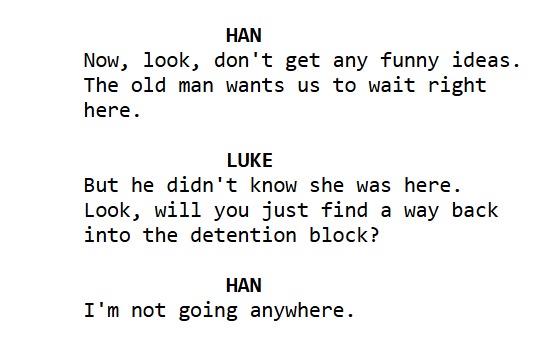
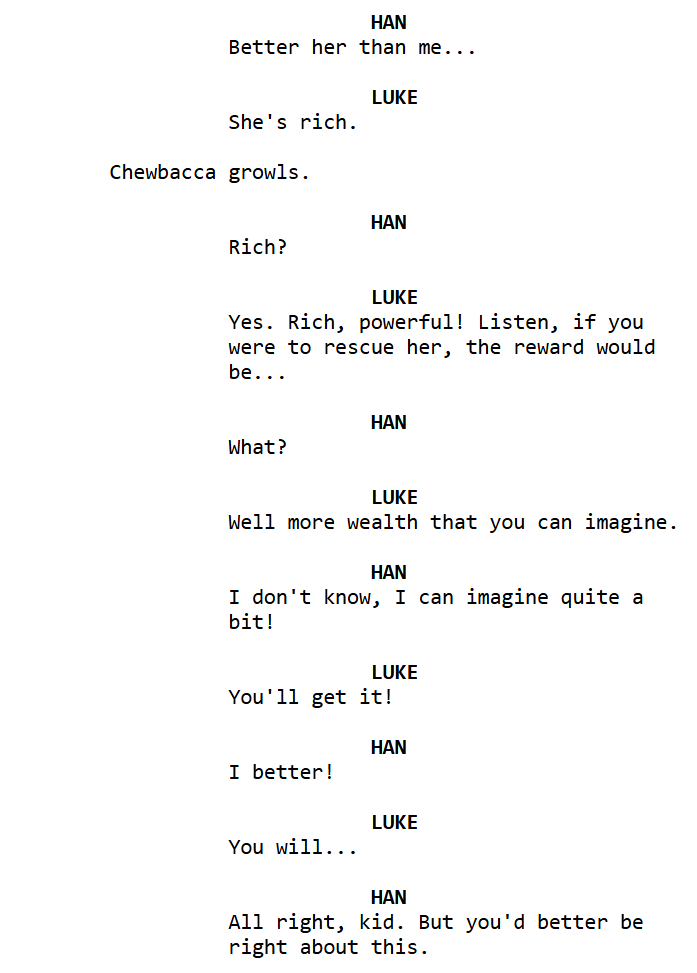
But even that’s not helpful if someone wants to play Han Solo, because Han Solo – almost by definition! – doesn’t want to go on this mission, really. Are we really saying that you can’t pick this clearly popular archetype? After all, Han Solo has to be dragged backwards through the movie to be involved, and everyone loves him.
This is the moment everyone is thinking of.
But the important thing to remember is…
Now, if you are looking with naïve eyes, you may think “this means that it’s the party’s job to convince the reticent character they want to be part of this game.”
This would be missing the key fact that Han Solo is a fucking idiot.
Imagine if Star Wars was an actual TTRPG. A classic Han Solo-esque player would have told Luke to sling their hook. It’s clearly a threadbare suggestion, and incredibly risky, and it all hangs on the say-so of this fucking farm boy they just picked up who’s already lost their old dude.
But the player of Han Solo in the film? Oh no. They’re all in. This half-arsed suggestion is all he needs. What they’ve done is used their character trait to create a scene which lets another player shine, and then buy into their answer completely. Rather than using it as a blockage, they’ve used it as a springboard. Rather than worrying about being cool, they have let the other player be cool. Which makes them cooler.
The fundamental mistake that a wannabe Han Solo player makes is thinking that it’s other players’ job to convince them they should play – when it’s in fact, by choosing to play an awkward character, it’s your job to work out why you remain in the game and go along with what’s happening.
It’s interesting that we’re used to thinking about Player Skill intersecting with the character class in terms of efficiently using the skills the class is based around… but we’re less likely to think about the character type in the same way. I think they’re actually identical.
If you’re playing a Han Solo finding ways to stay in the party is your problem in exactly the same way that working out how to throw a fireball and not kill your entire party is your problem as a wizard. If you didn’t want it to be your problem, you shouldn’t have picked the fucking class.
We love Han Solo for many reasons – but above all, we love Han Solo because he remains in the movie, on screen, and doesn’t leave at the forty minute mark, never to be seen again.
Because the one thing Han Solo never was, is boring.
 Log in